

Off-the-shelf software forces your business to adapt to its limitations. Custom software is built around your exact processes, your specific users, and your long-term growth plans – giving you a solution that works precisely the way your business works, and a competitive advantage that no competitor using the same generic tool can replicate.
We build custom software across web applications, mobile apps, enterprise systems, SaaS platforms, and AI-enabled solutions – from initial discovery through to deployment and ongoing maintenance.
Our team of highly skilled developers, engineers, and project managers possesses a deep understanding of the latest technologies and best practices.
We prioritize understanding your unique business challenges and goals to deliver tailored solutions that exceed your expectations.
We leverage the latest technologies, including AI/ML, cloud computing, and big data analytics, to build innovative and scalable software.
We embrace agile principles to ensure maximum flexibility, transparency, and client involvement throughout the development process.
Our team boasts a proven track record of delivering successful projects on time and within budget.
We thoroughly analyse your business requirements, user needs, technical constraints, and integration points, producing a detailed specification document and clear project roadmap forming the foundation for all development activities ahead.

Our UI and UX designers create wireframes, user flows, and prototypes that are reviewed, tested, and approved before development begins, preventing costly revisions and ensuring clarity across the product experience.
Using sprint methodology, our developers build software in iterative cycles, delivering working features frequently for review, ensuring transparency, continuous improvement, and progress throughout the project lifecycle from start to finish.

Comprehensive quality assurance includes functional, performance, security, and user acceptance testing to verify reliability, stability, and usability, ensuring the software performs correctly under real world conditions before release and deployment.
We handle deployment to your chosen environment, including cloud, on premise, or hybrid setups, managing configuration, data migration, validation, and go live support to ensure a smooth and launch experience.
Ongoing support includes performance monitoring, security updates, bug fixes, and feature enhancements, ensuring your software remains stable, secure, and scalable while adapting to evolving business requirements and term growth objectives.
Software development is the process of designing, building, testing, and deploying digital applications or systems that solve specific business problems or support operations.
It involves everything from planning and design to coding, testing, and ongoing maintenance.
Businesses typically need software development when:
While it may require a higher initial investment, it delivers long-term value through flexibility, efficiency, and the ability to adapt as the business grows.
Costs vary based on complexity, technology stack, and timeline.
Developer rates typically range from £30 to £150 per hour.
Accurate pricing requires a proper discovery phase to avoid budget overruns.
Timelines depend on project complexity:
Typical breakdown:
Agile methodology ensures early delivery of working features.
Waterfall is a linear process with fixed stages and limited flexibility. It works best when requirements are stable.
Agile is an iterative approach, using short sprints to deliver working features continuously. It allows flexibility, regular feedback, and evolving requirements.
Most modern teams prefer Agile due to faster delivery and reduced risk.
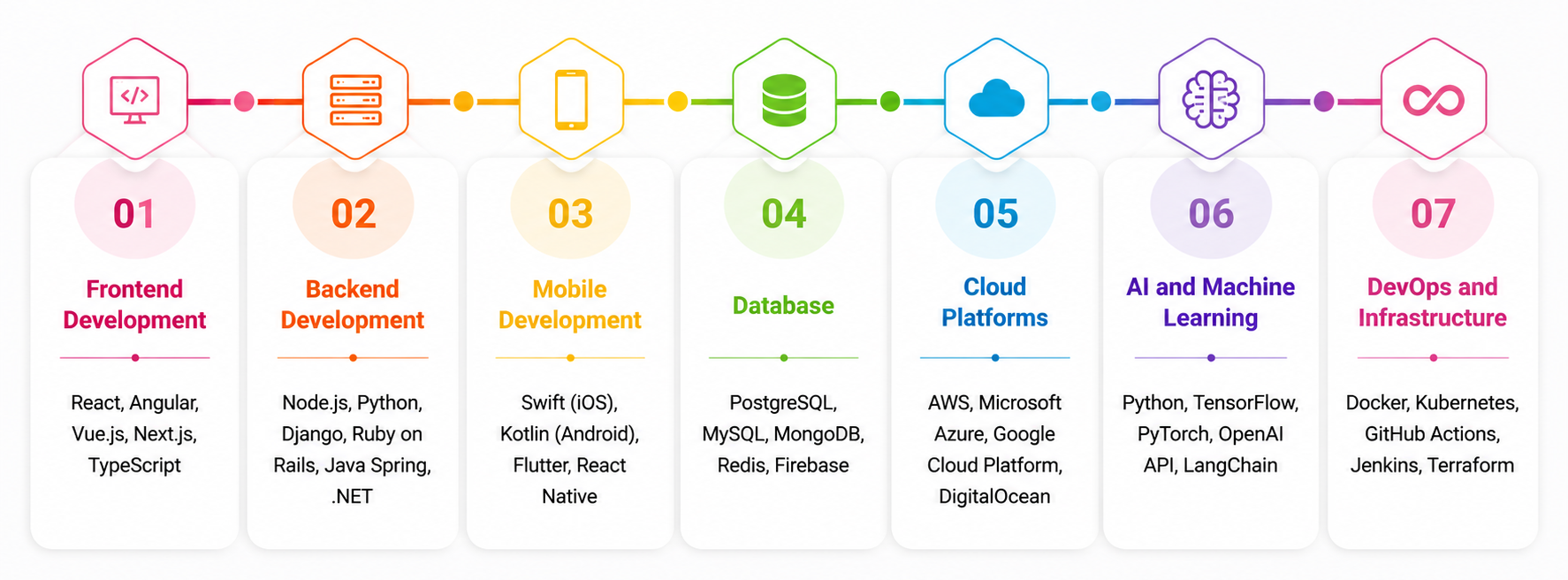
Technology stacks vary based on project requirements.
Technology should be chosen based on scalability, use case, and long-term goals
SaaS (Software as a Service) is cloud-based software delivered via a subscription model. Examples include Slack, Shopify, and Zoom.
Development includes:
Typical development time: 6–12 months.
In most cases, the client owns the code after full payment.
However, agencies may retain ownership of pre-built frameworks, libraries, or tools used in the project.
Contracts should clearly define:
Always ensure code is stored in a client-owned repository.
Off-the-shelf software is ready-made and widely used.
Custom software is built for specific business needs.
Key differences:
Most businesses use a combination of both.
Software maintenance ensures ongoing performance, security, and reliability.
It includes:
Businesses should budget 10-20% annually of the development cost for maintenance.
Key factors to evaluate:
A reliable agency provides detailed estimates after a proper discovery phase.